Skip to article
HEALTH DISCOVERY
EYE HEALTHAdvertorial
Macular health / Special report

NIH-Funded Research Identified Three Compounds That Rebuild the Protective Pigment in Your Macula. So Why Has Your Ophthalmologist Never Mentioned Them?

A growing number of eye health researchers say the standard approach to macular degeneration has been targeting the wrong thing for decades. Here's what the published science actually shows - and why almost nobody is talking about it.

8 min read
A woman reading at home
Reading a newspaper at home
01 / The question

What if everything you've been told is backwards?

If you've been diagnosed with age-related macular degeneration, you've probably heard some version of this:

"There's nothing we can do. Take these vitamins. We'll monitor it."

Maybe your doctor prescribed PreserVision. Maybe you found something on Amazon. Maybe you've been taking lutein for two years and your vision is still getting worse.

You're not imagining it.

And it's not because the vitamins don't work. It's because the ones you're taking are almost certainly incomplete.

But let's back up - because the real problem starts before the vitamins. It starts with a question almost no ophthalmologist is asking:

What actually causes macular degeneration in the first place?

A close-up of the human eye
02 / Under the surface

It's not a disease. It's a symptom.

Here's what most doctors will tell you: AMD is caused by drusen - those yellowish deposits that build up under your retina. Get rid of the drusen, slow the disease.

Here's what the research actually says:

A 2018 study published in the Archives of Ophthalmology found that drusen deposits are actually part of your eye's defense system. They're not attacking your macula. They're trying to protect it.

Think of it this way: drusen are the firefighters. And conventional treatment? It's trying to put out the fire by getting rid of the firefighters.

The real problem is underneath.

Your macula - the tiny area at the center of your retina responsible for sharp, detailed vision - has its own protective layer. It's called the macular pigment. It's yellow. It filters damaging blue light. It neutralizes oxidative stress. It keeps your photoreceptors alive.

When that pigment thins out - which happens naturally with age, but accelerates with diet, UV exposure, and inflammation - your photoreceptors lose their shield. They start misfiring. They start dying.

And here's what makes it cruel: you lose 40–50% of your photoreceptors before you ever notice a symptom.

By the time you're struggling to read the newspaper or recognize faces across the room, the damage has been building silently for years.

Macular pigmentPhotoreceptors
03 / A closer look at the evidence

This isn't fringe science. This is published, peer-reviewed research.

The connection between macular pigment and AMD isn't new. It's been studied for decades. But three landmark studies changed the conversation:

Swipe or use the arrows to explore each study.Continue the article
SpinachLutein
SweetcornZeaxanthin
FishMeso-zeaxanthin
04 / Why it is overlooked

If this works, why isn't everyone doing it?

This is the part that's hard to say without sounding cynical. But the answer is simple:

You can't patent lutein. You can't patent zeaxanthin. You can't patent meso-zeaxanthin.

They're naturally occurring compounds. No pharmaceutical company can own them. Which means no pharmaceutical company can charge $500/month for them. Which means no pharmaceutical company is funding awareness campaigns, training ophthalmologists, or running Super Bowl ads.

There's no money in a cure that costs $2 a day and comes from marigold flowers.

So the research sits in journals. Ophthalmologists know the compounds exist - they're in every retinal health textbook - but there's no pharma rep walking into their office with samples and a sales pitch.

This isn't a conspiracy. It's just economics. And it's why you've been taking a two-ingredient formula when the science clearly says you need three.

FoveaMaculaRetina
05 / The missing compound

If you've tried eye vitamins and felt nothing, here's why.

Let's talk about what's probably sitting in your medicine cabinet right now.

PreserVision AREDS 2 Formula - the most commonly recommended eye vitamin in America. Contains lutein and zeaxanthin. Does NOT contain meso-zeaxanthin.

Ocuvite - same story. Two carotenoids. Missing the third.

That eye vitamin you found on Amazon - probably just lutein, likely at a dose well below what was used in the clinical research.

Here's why this matters:

Meso-zeaxanthin is the carotenoid that concentrates at the very center of your macula - the fovea. This is the exact spot where AMD hits first. It's where you lose the ability to read, to recognize faces, to see fine detail.

Lutein and zeaxanthin protect the edges. Meso-zeaxanthin protects the center.

Taking a formula without meso-zeaxanthin is like locking every door in your house except the front door. It's protection - just not where you need it most.

So if you've been taking eye vitamins for a year and your vision hasn't improved - or it's still getting worse - you weren't doing it wrong. You were taking an incomplete formula. You were getting half protection.

What Eye Care Professionals Are Saying

Time with family
06 / Everyday vision

Your macula wants to heal. It just needs the right conditions.

Here's what the research tells us that your doctor probably hasn't:

Your macula regenerates protective pigment every single day - when it has the raw materials to do it.

The three macular carotenoids - lutein, zeaxanthin, and meso-zeaxanthin - cross the blood-retina barrier. They embed directly into the macular pigment layer. They filter blue light. They neutralize oxidative damage. They protect the photoreceptors that give you sharp, central vision.

This isn't about slowing the decline. The published research shows that when you give your macula all three compounds at the doses used in clinical studies, the pigment rebuilds.

Denser pigment. Stronger protection. Photoreceptors that can function the way they're supposed to.

What does that look like in real life?

  • Reading the newspaper again - not with a magnifying glass, just reading it
  • Recognizing your grandchild's face across the room
  • Driving at night without white-knuckling the steering wheel
  • Waking up to colors that are vivid again - no blur, no fog, no dark spot stealing the center of your vision
  • Looking at your spouse and seeing them smile - because you can actually see them clearly

That's not fantasy. That's what the published research describes when macular pigment density increases.

SEE+ mixed berry powder
The formula

One formula actually got this right.

There are very few companies that use all three macular carotenoids at clinical doses. Most skip meso-zeaxanthin because it's expensive. Most don't formulate for absorption. Most are just checking a box.

One company built their entire formula around the science above - all three carotenoids, at the exact doses used in the NIH research, engineered for absorption, third-party tested.

They also added supporting compounds that the research shows matter: astaxanthin, saffron extract, bilberry - 14 ingredients total.

It's called SEE+, and it works differently than anything you've tried before.

Spinach, a dietary source of lutein

Lutein - 20mg (clinical dose from AREDS2)

Sweetcorn, a dietary source of zeaxanthin

Zeaxanthin - 2mg (clinical dose from AREDS2)

Fish

Meso-Zeaxanthin - 2mg (clinical dose from CREST AMD)

More of the 14-ingredient formula

Shrimp, a dietary source of astaxanthin

Astaxanthin One of the most potent natural antioxidants known. Crosses the blood-retina barrier.

Saffron crocus and threads

Saffron Extract Shown in studies to improve retinal flicker sensitivity in AMD patients.

Bilberries

Bilberry Extract Supports retinal blood flow and night vision adaptation.

Kiwi

Zinc, Vitamin C, Vitamin E, Copper Foundational AREDS2 nutrients.

14 ingredients total. Engineered for absorption. Third-party tested.

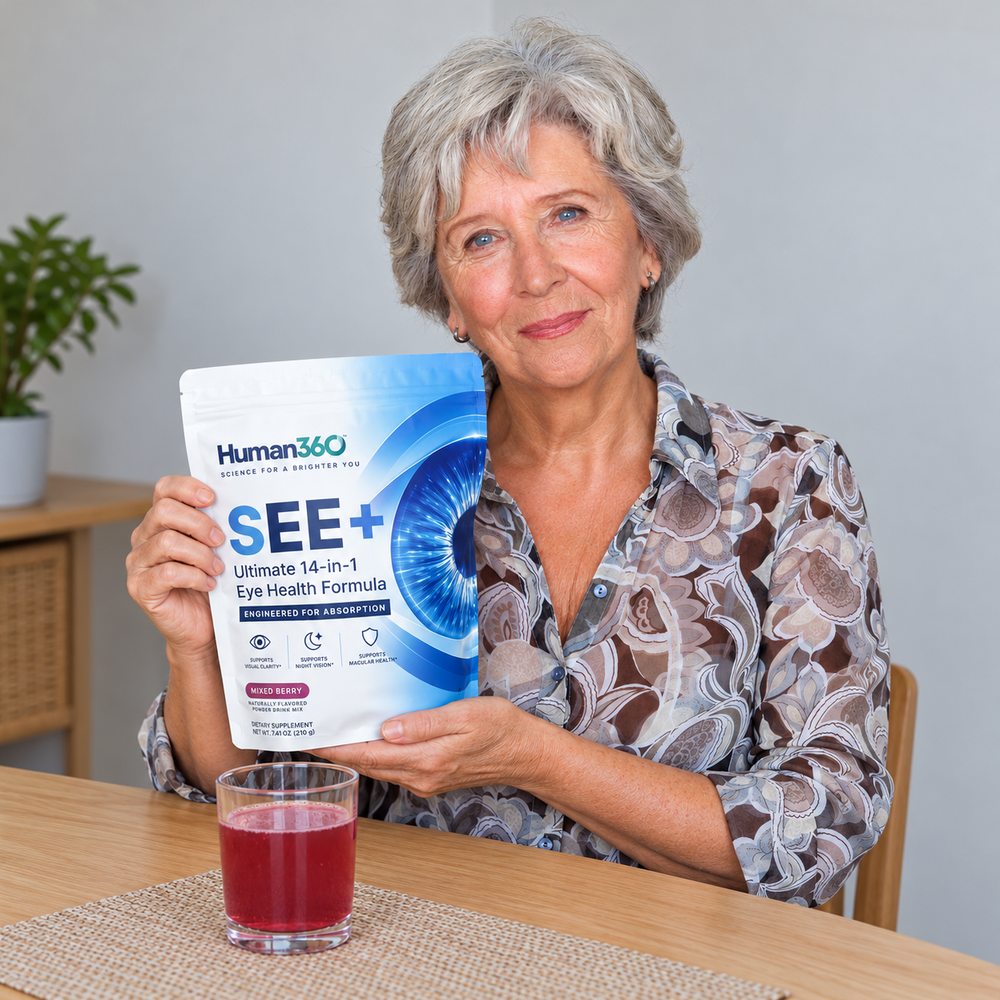
Gray-haired woman with SEE+ and a mixed berry drink

A daily drink. Not a handful of capsules.

SEE+ is a mixed berry powder you mix with water or juice. Enjoy it once daily, following the label, with all 14 ingredients in one drink.

References
  1. Age-Related Eye Disease Study 2 (AREDS2). National Eye Institute, National Institutes of Health. (2013). JAMA, 309(19), 2005–2015.
  2. Nolan, J.M., et al. "Enrichment of Macular Pigment Enhances Contrast Sensitivity in Subjects Free of Retinal Disease: Central Retinal Enrichment Supplementation Trials – Report 1." IOVS, 2016.
  3. CREST AMD Trial. Akuffo, K.O., et al. "Central Retinal Enrichment Supplementation Trials (CREST) – AMD." Waterford Institute of Technology, 2014.
  4. Bone, R.A., et al. "Macular Pigment and the Role of Meso-Zeaxanthin in the Central Retina." Archives of Ophthalmology, 2018.

This article is for educational purposes. Individual results may vary. Consult your healthcare provider before starting any supplement regimen.